Once I was Ashastû – son of Darsha and a resident of the ancient city of Nishapur. Once I was a bird, imprisoned by a gilded cage. I was the follower of Mazdayasna and the worshipper of Ahura Mazda.
Like a butterfly, which once was a caterpillar, I was all that but no more. Now, I have become the bearer of the most ancient of all the legacies – the legacy of forgotten wisdom. This is the story of my transformation and my transition, from a caterpillar to a butterfly; and from the path of dark ignorance to the path of bright wisdom.
My family had been serving the grand temple of Nishapur since the times of the great Zarathustra. My father was amongst the most respected leaders of the Council of Mobeds. He was also the Chief Priest of the Temple of Fire and the Custodian of the Towers of Silence.
My father was kind and affectionate and wanted me to take his place one day, once it was his time to return to the lap of Ahura Mazda. But I was a free spirit – an eagle living under the shades of the great grey mountains. An eagle, who was waiting for his chance to ride the mighty shoulders of wind; and make his nest atop the summits of the snowy peaks.
Nishapur was not an ordinary city. This Persian city was the capital of the Province of Khorasan and attracted intellectuals and artisans from as far as Jerusalem and Taxila. The city was filled with gold and riches, thanks to the never-ending turquoise mines.
It was a tough and resilient city. It survived the raids of the rebels fighting the Sasanids and the Samanids. It survived the onslaught of the Tahirid and the Seljuq forces, and it also survived the devastation imposed by the Mongols. In fact, the city’s survival against the Mongols was nothing short of a miracle.
The devils from the Khanate in Mongolia slaughtered the entire population of the city within days. A few citizens including my family, saved their lives by hiding in caves, masked by the slopes of the Binalud Mountains. But something deep within the city’s carcass kept breathing; and after the fall of Khwarezmia at the hands of the Mongols, Nishapur kept on thriving under the Shiites. Along with the great cities of Balkh, Merv and Herat, it evolved into an intellectual, commercial and cultural gem.
Nishapur was a colourful city with a life of its own. But, with all its charms and knowledge and with all its riches and women, the city was unable to keep me chained to the feet of my father. I was waiting for my chance to fly away and my father knew this.
‘Ashastû! My son! You are going to get lost in the world out there.’ He used to say, gracefully attired in his flowing white robes.
‘Yes, father!’ I used to bow my head with a tiny and rebellious smile dancing around the corners of my lips.
‘Stay here with me and one day the spirits of our ancestors will bring peace to you.’
‘But the spirits live beyond the frontiers of space and time. Won’t they be able to bring peace to me wherever I am in this whole wide world?’ I used to tease him, feeling confident in the warmth of his paternal affection.
‘Do not exploit the love of an old man, Ashastû. I love you my son and would like you to stay here with me till the day I breathe my last.’ His moist eyes used to plead.
‘If you truly love me, Father….’ I used to beg in return, ‘…..you would let me go wherever I want to go.’
Then one day, a great caravan from Kashghar crawled like a great serpent through the grand city entrance. To the city of Nishapur and its countless dwellers, the caravan was nothing out of the ordinary. But for me, the caravan was the wind, the eagle within me was seeking. Once it left Nishapur a few days later, I was riding one of the camels, concealed by the grey and brown of an old tattered robe.
Once I left Nishhapur, I never looked back. It was my dream to see the world stretching beyond the horizon imposed by the mighty mountains. That world I saw with my eyes and felt with my heart. With each new journey, came a new adventure.
I carried along a copy of the Avesta, the collection of the Zoroastrian’s sacred texts. The ancient book, the obscure prophecies hidden within its disintegrating pages and my understanding of the verses, were all I had to earn my livelihood. I was willing to trade my religion for my survival.
The caravan followed the southern shores of the Caspian Sea and entered Azerbaijan. I smelt the salt-laden air kissed by the snow and peered into the grey eyes of the wild mountain women. I found the majesty of the icy peaks reflected in those eyes. The freedom of my soul fell in love with the freedom in those grey eyes. But I had to move on and I moved on, leaving a piece of my heart buried in the white snow.
The caravan moved through Armenia and then Georgia and reached the great city of Smyrna in Turkey. The captivating architecture and the minarets with their high spires lost within the white billowing clouds, stimulated my curiosity. The music of lyre and the smells of spices intoxicated my soul and incited my sensuality. I wanted to study the graceful curves of each marble dome and feel the textures of each sun-dried brick. But I had to move on and I moved on, leaving a piece of my soul tied to the pigeons of Smyrna.
The caravan moved through Babylon and Mesopotamia and then back into Persia. It crawled along the Persian Gulf and re-entered Khorasan. The caravan did not stop either at Kandahar or Ghazni except for a day or two, and kept moving until it reached the feet of the great Buddhas of Bamiyan.
Bamiyan awed me. The Buddhas, managing to look humble even in their silent grandeur, captivated my imagination. There they were, carved into the side of a great mountain, looking down on the wandering Hazara tribes. I used to sit on a rock facing the statues and think of Budhha – the Prince who abandoned the rich comforts of his palace in search of peace and wisdom.
I loved Bamiyan so much that when the caravan left, I stayed behind. But it was not my interest or curiosity in the Buddhas which made me stay in Bamiyan. Rather it was my dark fate, which perched upon a lonely ledge of the naked mountains; and stalked its ignorant prey. Then one day it dived down from the ledge. It hid her dark ugliness behind the sweet and lovely face of Zahran and introduced me to the yet alien feeling of love.
One summer morning in Bamiyan, I was sitting at my usual spot and was lost in a reverie. The day was bright and peaceful with a few soft clouds floating on the clear blue sky.
‘Who are you and why do you sit here every day?’ The gleaming steel of a delicate but firm voice neatly sliced the silence.
I slowly turned my neck and looked at my nemesis. There she was, riding the most beautiful horse I had ever seen. It was tall and had gleaming black satin skin stretched over wonderfully formed muscles. Its long mane was knit into braids, each tied with a small silver bell at the end, and the leather saddle and straps looked as soft as velvet and were dyed a dark hue of purple.
My gaze remained fixed on the delicately carved silver spurs attached to the black leather saddles for a moment and then climbed up slowly. My eyes traced the firm contours of muscled and well-toned shins and thighs. The rider had an excellent taste in clothes and her dark velvet apparel spoke of her high status.
My gaze finally reached the face where a pair of emerald eyes were staring at me with curiosity. Two bushy eyebrows stretched like scimitars over those lovely eyes. Nothing else was visible as a purple silk scarf covered her face.
‘I am Ashastû of Nishapur.’ I answered while getting up. ‘And who might be you my lady?’
‘I am Zahran.’ She briefly answered and kept staring at me.
‘Zahran who? Queen of the Dark Night or Guardian of the Golden Sunlight?’ I asked with a smile.
‘Zahran, the daughter and only child of Katib Ahang – the Chief of all Hazara tribes.’ She answered haughtily and then turned her horse and galloped away.
I kept on standing there for ages, my senses numbed by the fragrance diffusing the clear mountain air all around me. It was the fragrance of the night-scented jasmine and it seeped deep into my heart.
Zahran, who she might have been and what she might have been, became my destiny in a few fleeting moments. I forgot that I was a traveller. I forgot that I was away from my home and in a foreign land of strange customs and traditions. All instincts of safety and survival abandoned me and were replaced by the vision of two emerald eyes, peering at me from behind a silk scarf.
Of course, I had heard of her father, Katib Ahang – the cruel and despotic tribal chief of all Hazaras. Whoever spoke of him, spoke with a fear-inspired deference. I knew where he lived. It was a navy blue pavilion, the colour of the night sky, on which a silver flag waved at the mercy of the crisp mountain air.
From that day onwards, I sat in the same spot every day and at all hours, waiting for Zahran to return. I forgot all about the grand Buddhas and I stopped revelling in the sad majesty of the lofty mountains. Zahran became the centre of my universe. Her memory became the fire around which my mind circled like a moth. I breathed in her name and breathed it out. I was a man struck by the thunderbolt of love. I was a doomed man.
Days changed into nights and nights transformed back into days. The sun and the moon followed each other from horizon to horizon. Then one day, while I was sitting at my usual spot, something cold and wet fell on my head. I looked up. Snow had started falling. Winter had come to Bamiyan and with it came a freezing wind, chilling my bones. Zahran didn’t come but I kept on waiting for her.
It was an extremely cold morning when the gods chose to smile down at me. There was a harsh wind blowing from the North. But I was oblivious to all. I was sitting cross-legged, facing the Buddhas with my eyes closed and vision filled with the beauty of emerald eyes. Suddenly I heard the sound of hooves thudding upon the soft carpet of snow.
When I heard the tinkling of silver bells along with the sound of hooves, my heart leapt with joy. But I didn’t get up. Ashastû of Nishapur was in love but he was also patient.
‘Who are you and why do you sit here every day?’ Her voice still sounded the same – gleaming steel slicing the thick blanket of silence.
‘I am Zahran’s slave and I wait here every day for her.’
My heart had stopped beating in the anticipation of a response. But there was only silence. Finally, I decided to turn around. There on her tall horse, sat my beloved – clad in an ebony-coloured gown. Her emerald eyes were staring at me and through me, their green depths betraying nothing of what was going on in her mind.
‘I find you interesting – Ashastû of Nishapur.’ Zahran decided to speak.
‘Then I am the luckiest man on earth. Let death come and I will willingly embrace it for I have found all that I ever desired and all that I ever will desire.’ I approached the horse, placed my hand lightly on the reins and bowed my head.
‘One never finds all he desires. Don’t be absurd.’ Her eyes smiled at me.
‘One does if he learns contentment.’ I smiled back at her.
‘So, are you content, Ashastû?’
‘Yes, I am……now.’
She got down from the horse and we sat together on the boulder.
‘What do you desire most in the world?’ She asked, after a few moments of fragrant silence.
‘Interestingly, I always thought I desired freedom the most. But….’ I deliberately left my sentence frozen in the cold mountain air like an icicle.
‘But?’ She asked softly.
‘But that was before I met you Zahran. Now I desire you the most.’ I picked up some courage and delicately touched her hand.
She laughed at my answer and her laughter was the sound of silver bells riding the early morning air.
‘Ahh! Desire….the most temporary and fragile of all human feelings.’ She subtly pressed my hand back.
‘One moment, the desire overpowers us and intoxicates us with its heady perfume; and the next, it dissolves into nothingness, making way for the next desire. But if fulfilled, it transforms into the stink of regret.’
‘My desire for you is nothing like that. It is here to stay in my heart – forever.’
‘Forever?’ She laughed again. ‘Forever is a word that suits only our creator. We, humans, can just live in the moments and can only dream for a forever.’
We sat together for some time and then seeing a few horses leave her father’s camp, she hurriedly left. But that was not our last meeting. Instead, it was the first of many such meetings. Each time we met, I expressed my love and each time she brushed aside my submissions with laughter. But as steadily falling drops of water engraved and carved a stone, my words of love, slowly and gradually melted Zahran’s heart.
Seasons changed – winter gave way to spring and summer and autumn heralded the advent of another reign of harsh coldness. But our young hearts, warmed by love and passion, were oblivious to the cold winds raging outside.
Then one day, Zahran did not come. I waited and kept on waiting. First for a day, then for a few days and then for weeks. When a whole month passed and she didn’t come, I knew something was amiss. Without reflecting on the consequences, I decided to go check one evening.
The pavilion of Katib Ahang was not very far from where I lived. I approached it stealthily. It was dark in the valley but brighter than daylight around the pavilion. A thousand torches burned brightly, illuminating the lower expanse of the grand canvas structure.
The place was thickly manned by a battalion of menacing-looking sentries – some on foot, while the others rode tall horses. My heartbeat was throbbing in my ears and I could smell the stink of my raw fear. But still, the memory of a fragrance – Zahran’s fragrance, kept me steadfast.
‘Who goes there?’
‘Who moves like a thief amidst the shadows?’
‘Halt! Or you will be slain like a filthy pig.’
Suddenly, frantic and threatening cries halted my feet. My foolish presence had been detected.
In a few moments, I had been caught by the sentries and my hands and feet were bound tightly. They threw me into a dark dungeon. A few nights passed and no one interrogated me. The guards were silent as trees and my desperate queries were met only by cold eyes.
Then one morning, the dungeon gates were opened, and I was bound again and dragged to the Chief’s pavilion.
The pavilion indeed looked grander from the inside. The canvas was covered by maroon velvet embroidered with gold, while the high steel and bamboo pillars were decked with golden fixtures. The floor was strewn with Afghani and Persian carpets, so luxuriously soft that I found my toes digging for hold at each step. Towards the farther end of the pavilion and in front of a black silk curtain, sat the Chief.
Katib Ahang looked young for his age. His hair was still black and scattered on his wide shoulders. Beneath a wide forehead, two dark eyes glared at me, but not with malice. Instead, there gleamed a strange curiosity. If I was not wrong, there was even a hint of a smile on his thin lips. But that was all deception. He was rumoured to be wise yet cruel and fair to the point of strict rigidity.
Katib flicked his fingers and I was pushed forward. I could hear subdued snickering all around me. A stranger was definitely not welcome amongst that strange company. I was surprised to see women sitting amongst the men, not as subjects or objects, but as equals. I was aware that Hazara women formed part of the council of elders but I didn’t know that they participated in the court proceedings so openly.
‘Who are you and why are you here in Bamiyan?’ Katib Ahang inquired softly.
‘O’ mighty and noble chief of all Hazara tribes, I am Ashastû of Nishapur.’ I submitted in the humblest tone I could muster.
‘Well, that answers my first question. What about the second question?’ Katib’s voice rang with impatience.
‘I came to Bamiyan by chance. I stayed in Bamiyan by choice. And I remained in Bamiyan by a stroke of fate.’ I bent my head.
‘Nothing happens by chance for every occurrence has a reason. The choice is rational but fate is only what we make out of our circumstances.’ The Chief chewed on each word of his.
For a few moments, nobody spoke. Even the whispers and snickering had died down. All was silent in the court of Katib Ahang; while the Chief‘s steely gaze scrutinised me from head to toe and he scratched his short pointed beard.
‘What do you do for a living, Ashastû of Nishapur?’
‘I am a follower of Zarathustra and a believer in Ahura Mazda. I am a religious scholar and a seeker of eternal truth. I am a traveller and a lover of freedom.’ I raised my head, stared back into his eyes and answered confidently.
‘Hmm!’ He scratched his beard again. ‘What were you doing near my pavilion the night you were caught? There is neither any eternal truth nor freedom to be found here.’
I couldn’t find any words to answer that question so I stood in silence.
‘No answer eh?’ Katib’s voice mocked me. ‘Perhaps you are not a religious scholar and a seeker of truth, but only a common thief.’
‘I am no thief O’ mighty Chief.’ I protested. ‘But I am afraid of telling the truth.’
‘Truth is the only force that will set you free, Ashastû of Nishapur. Speak the truth and I will respect your words. Only if I find them free of the poison of deception. But if I find even a hint of cleverness and lies, I will have you quartered by four strong horses.’
For a while, we both kept staring at each other. I thought of many possible lies. Perhaps I could tell him that I had lost my way. That was believable and logical. Or I could tell him that I wanted to witness the grandeur of his pavilion first-hand so that I could go back and tell my countrymen of his magnificence and might. That could have flattered him surely. But then reason abandoned me and I decided to tell the truth.
‘I came here to search for Zahran, your daughter.’ My answer was the spark to the fuse of a cannon.
A cacophony broke out and there was even the sound of a few swords and scimitars being unsheathed. But I refused to look around and kept on staring at the Chief. The colour of his face changed to red for a moment. He almost got up from his throne and started to speak but then controlled himself and sat back.
‘Silence!’ Katib snarled and the chaos around us died down abruptly. ‘And why were you searching for my daughter?’
‘Because I love her and was worried about her absence. I feared that some sickness or malady had overcome her. But as I had no means of inquiring about her well-being, I decided to come check myself.’ I was growing fearless by the moment. Now that the truth was out in the open, I wasn’t afraid of death any more.
‘Are you crazy or mad? Don’t you fear for your life young man?’ Katib inquired while impatiently rubbing his hands.
‘He is neither crazy nor mad.’ Zahran’s beautiful voice rang out from behind the black curtain. ‘He speaks the truth, Father. He loves me and I love him.’
Katib was startled by Zahran’s answer. He looked at the curtain and then at me and then back at the curtain again. He looked unbelievingly at his council of advisers and ministers, all of whom looked equally startled and shocked. It was a strange day in the court of Katib Ahang. He gave me a final look of disbelief and then held his hairy head in his hands and shut his eyes.
‘Do you belong to an illustrious family – perhaps a line of ancient kings?’ The Chief raised his head and asked me. He looked old. Truth has that impact. It ages people.
‘No, I do not belong to a line of kings O’ mighty Chief of Hazaras. But my family is noble and I can trace my lineage back to the times of the great Zarathustra. My father is the Chief Priest of the Temple of Fire and the Custodian of the Towers of Silence in Nishapur. He is the Chief of the Council of Mobeds and is respected by the followers of all religions alike.’ I clasped my hands and explained with respect.
‘He is an infidel.’
‘He is the worshipper of fire.’
‘He dares to dishonour the Hazaras and our noble Chief.’
‘He should be killed.’
Chaos broke out in the court again.
‘Enough!’ Katib raised his hand and silenced the audience.
‘It is true that we are the people of one true faith. But it doesn’t mean that we do not honour the truth and the decisions of our women. Hazaras are noble not because of their lineage or race. We are noble because we honour truth and we honour our women. And one doesn’t honour women by taking away their right of choice; one honours women by respecting their decisions.’
I breathed a sigh of relief and gave myself a pat for sticking to my instinct.
‘But!’ Katib spoke again. ‘Zahran is no ordinary woman. She is the Princess of all Hazaras. For the honour of all Hazaras, she has a right to exercise her choice only if her choice proves his merit.’
‘I am ready for any test. I am even ready to give my life to prove my love for Zahran.’ I bowed my head.
‘I agree too. You can test him, Father, for I have an absolute confidence in my choice.’ Zahran spoke from behind the curtain.
‘You are a seeker of truth you say?’ Katib looked at me sternly.
‘That I am O’ mighty Chief.’ I was at my humblest.
‘Then give me the answer to these three questions and Zahran will be free to marry you.
What is God?
What is religion?
What are prayers?’
I listened to the three questions and processed them with unease. I looked up and saw that Katib was smiling.
‘But all these….all these are absolute questions and only absolute truths can answer these questions. Nobody can find absolute truths.’ I protested.
‘Even absolute questions can be answered satisfactorily, provided the answers are founded on reason and logic.’ The Chief waved his hand.
I nodded my head in agreement and that was that. The deal was struck.
The next morning, Zahran along with a few riders from her father’s guard bade me farewell at the borders of Bamiyan. I looked at her face and instead of tears, there was confidence lighting up her eyes. She knew and she believed in my capabilities. I had to prove myself worthy of her belief and confidence. With a heavy heart, I waved at her one final time and started climbing the mountain path.
I had nowhere in particular to go. I didn’t know where the answers could be found. But trusting some instinct deep inside my heart, I decided to travel towards the North.
My path was strewn with innumerable difficulties.
I crossed the lands of the wily Turks. They looked at my tattered clothes and mistook me for a Sufi. Nobody asked about my identity or religion. I passed through them unharmed.
I came across the cruel and bloodthirsty Uzbeks. Their marauding bands caught me and then released me, unable to determine my nationality. I passed through them unharmed.
I passed through the tribes of the Kazakhs. One look at me and the robbers knew I did not carry any valuables or money. They even took pity on me and I passed through them unharmed.
It was like some force of nature was guiding my path and protecting me against all odds and all harm. The swords froze mid-air while plunging down on my neck; and daggers seeking my blood were withdrawn at the last moment. When I was thirsty, I found sweet mountain springs; and when I was hungry, I found either game or kind villagers.
One day, while I was getting tired of following the endless curves of a mountain river, I reached the feet of a mighty mountain range. The stones and rocks were all shades of black, white and grey. About a few hundred feet up on the slope, there was a building made of blackened and aged wood and stone. It was two stories high and smoke rose out of its chimneys. I had reached a caravan sarai.
After many negotiations and pleas on my part, the owner of the sarai agreed to let me spend a few nights there; in return for my agreement to entertain the guests each night.
It was a strange place. I could see a hundred or so travellers, each having a different nationality and a unique set of features. This by itself was not strange. Caravan sarais are supposed to be melting pots of many cultures and nationalities. But what I found strange was that none of those guests was a tradesman.
There was a thin naked sadhu from Benares in India; his naked body glistening at all times with the fat of dead animals and sometimes smeared with ash. I was fascinated by the markings on his forehead and his knotted hair and yoga asanas.
There was a young woman with flaming red hair; her green eyes betraying her Nasrani ancestors. The owner of the sarai called her a witch; an accusation which she neither denied nor confessed to. I was entranced by the fluid way in which her body gyrated, while she danced to the strange beat of some invisible music.
There was a Tibetan Buddhist monk; his head as bald as eggshell and his face filled with lines deep with age and experience. I marvelled at the sea of calmness reflected in his expressionless eyes and his slow deliberate way of doing each routine task as it was some mystic ritual.
And then there was a shaman from some unknown lands; his long hair adorned by the most marvellous-looking feathers of exotic birds. I was captivated by his deep guttural incantations and his throat singing, which resonated with something deep inside me.
One night, I was sitting by the fire burning in the middle of the sarai’s courtyard – huddled in my tattered blanket and unable to sleep. Suddenly, I felt someone staring at me and looked around. Everyone was either busy or asleep. No one was interested in me. But the feeling of being stared at, persisted strongly.
I closed my eyes and the wise words of my far-away-father, echoed in my ears:
‘When there is a sensory perception but you cannot find its origin, close your eyes and regulate your breathing. Breathe in and breathe out. Cancel out the noise of the world around you. Slowly and gradually, the origin will reveal itself to you.’
I regulated my breathing. Then ten breaths in and ten out – each of equal duration. When the world fell silent around me, I opened my eyes. I again searched the shadows and finally was successful in sensing a movement. I focused onto it and slowly, the shadows transformed into a definable physical shape and the Shaman stepped out of the darkness and approached me.
He wasn’t walking. Instead, he was dancing. He was taking slow deliberate steps – two forward, one back, two forward, one sideways and then again two steps forward. Nobody around us was playing any instrument but I thought I could hear the weeping of the lyre and the beating of the unseen drums. I looked at him, totally entranced.
The Shaman came closer and started dancing around me. He completed one circle around me and then another in the opposite direction. But all that time, his half-closed eyes remained fixed on me. Then suddenly he stopped and raised his right hand in the hair. My eyes followed the direction his index finger was pointing in. There, in a window on the top floor of the sarai, stood a woman with the palest and most featureless face I had ever seen. Her long hair fanned her shoulders. She was looking at me intently. Then she raised a hand and motioned at me to join her.
I had never seen that woman at the sarai before that moment. She was probably a new guest. I wanted to ask the Shaman about her, but he had vanished – dissolving like smoke in the night air. I looked around and searched the shadows. He was nowhere to be found.
Scratching my head in confusion, I got up, adjusted the blanket around my shoulders and entered the building. The owner was sitting behind a stone counter, busy doing some calculations in the weak lamp light. Sensing my presence he looked up and stared at me questioningly.
‘I have been summoned.’ I offered confusedly.
‘By whom?’ He sounded almost bored.
‘By a woman.’
‘There is no woman in the sarai. The witch was the only woman and she left this morning for the Lake of Grey Shadows.’ He chuckled softly.
‘I saw an old woman standing in a window.’ I insisted.
‘Well! We see what we want to see and not what is there to see. Go on then. Go see what the woman wants.’ He waved his hand at me disinterestedly and bent his head to his figures again.
I grabbed a burning torch from a wall and started climbing the dark stairs. The top floor was all dark and quiet. All the doors were closed shut and looked the same. However, one was different from others. While all others were made of dark wood, this particular door was made of some strange metal which glowed in the dark. Rather, while the door itself provided a dark background, certain carvings on it pulsated with a strange glow.
I looked at the carvings closely. They looked vaguely familiar. I moved back a little and then suddenly I understood. Those were not random carvings. Instead, from a certain angle and when viewed in totality, they formed a symbol. It was the figure of a bearded and crowned man with spread wings.
The symbol was not alien to me. It represented Faravahar, a significant symbol of my religion, which represented many different things like sins, virtues, loyalty and faith. But above all it represented truth.
I took a deep breath and knocked softly on the door. The moment my knuckles touched the door, the glowing lines of the symbol rearranged themselves into figures. Those were all awful figures. There were souls writhing in agony and tortured spirits begging for mercy. For a moment I was startled, but then I comprehended what was meant by it.
It was the door to the truth but truth is the most torturous of all revelations. It comes with a heavy price – the price that has to be paid in coins of anguish and misery. I asked myself if I was really ready to pay that price. Something inside me was convinced that whatever I sought, was to be found beyond that door. I thought of the sweet face of Zahran and her magical emerald eyes. I took another deep breath and knocked again. The glowing lines extinguished abruptly like a flame snuffed between two fingers and the door went dark. I knocked for the third time.
‘Enter!’ A quavering voice commanded from beyond that door and the door opened by itself.
From the threshold, all looked dark inside. But the moment I closed the creaking door behind me, the room lighted up.
It was a small room not unlike others in the Sarai, but far more decorated and rich with hanging tapestries. The walls were covered by dark heavy folds of blue black velvet, adorned with ornate drawings and writings in gleaming silver. There was a wolf’s skin, complete with the snarling jaw and sparkling beady eyes, lying in the middle of the floor. There was a bright warm fire lit in the hearth and someone was sitting facing the fire.
It was a small hooded figure – most probably the old woman who beckoned at me from the window. She was wearing a deep purple silk gown, but the rich colour was fading fast with age. But even within the folds of fading silk, intricately woven and embroidered dragons and other mythical beasts were visible.
‘Come sit down with me.’ The woman patted the small wooden stool at her side without looking at me.
‘Who are you?’ I sat down and tried to look at her face. But it was hidden by the fall of the silk gown.
‘I am the weeping wind in the willows,
which sighs and passes into silence’
Her sing-song voice rose like a lament.
‘I am the weeping wind in the willows,
which sighs and passes into silence
I am the song of the grasshoppers,
which comes after the rains
I am the bright sun of joyous life,
which seems to shine eternally
And I am the pale moon of death,
which comes after the sun has set
I am what was and I am what is;
and what will be and what could have been
I am the riddle and I am the answer,
I am the woman in the porcelain mask.’
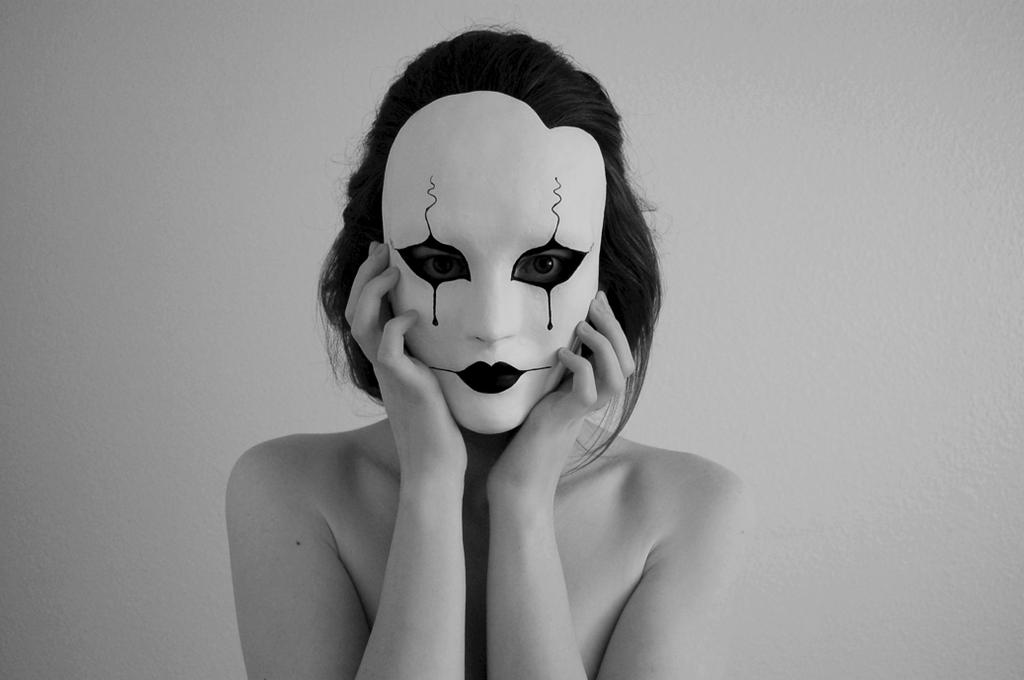
With the last words she looked at me and I was startled. There was no face. Under the crown of magnificent silver hair, there was an expressionless and delicate white mask of porcelain, covering all her features. She was old – of that I was sure. But how old? I had no means to assess her age.
‘I haven’t understood any of what you have said.’ I humbly confessed my failure.
‘You will understand.’ Her voice told me she was smiling underneath that mask. ‘You will understand all at the right time. Not before that and not after that – but only at the right moment.’
‘But who are you?’ I asked respectfully asked.
‘I was once a princess of the Song Dynasty. When the Mongols attacked China, I was a prized catch. Kublai Khan took one look at me and his heart surrendered to me forever. I became one of his many beloved wives. With time I learnt to overcome my hatred for the Mongols – the killers of my noble family.’
She fell silent and started prodding the dying flames. The sparks hiding beneath the ash resurfaced with a fury and the room was warm again.
‘Alas! Life is a series of sorrows separated by a few small joys. One day when I was travelling with a caravan to join my husband on one of his hunting expeditions, I was kidnapped by the Hashisheen.’
‘Hashisheen?’ I asked. The term was strange to me.
‘Yes, Hashisheen – the crazy followers of the Old Man under the Mountain. They were a fearsome lot. The Old Man, Hassan bin Sabah and his mad followers, had created a force of chaos. Theirs’ was the power of death and the instruments of death were a band of young men – all blinded by visions of heaven and hell.’ She answered without looking at me and then suddenly shivered as though the memory of some dark place was still haunting her senses.
‘Visions of heaven and hell? How did the Old Man manage that?’ I was surprised.
‘Hasheesh is a strange drug. It dulls the senses and makes you see visions in the smoke. Besides, the heaven and hell were real. I was myself one of the houris of that heaven. One look at our naked bodies and the boys were ready to kill just to have another look.’
Suddenly a wailing chant from the courtyard disturbed our conversation. It was the Shaman. The old woman stood up and went to the window. She stood there watching the shaman for a while; and then raised her right hand and said sternly:
‘Be quiet you fool. Your job is done. Go find a dark corner and rest in peace.’
With these commanding words, the Shaman stopped chanting and silence ruled the night air once again. She turned back and walked back to her place by the fire.
‘Enough about me.’ She said staring at me. ‘Now ask the questions you are seeking the answers to.’
‘Questions?’ I was startled. ‘But how do you………?’
‘Don’t be a fool. Ask the questions before the night turns into day.’ She raised her hand and silenced my query.
‘The first question………’ I scratched my chin. ‘What is God?’
‘Are you familiar with the ancient Greeks?’ She asked.
‘Yes, somewhat.’ I couldn’t grasp the tangent our conversation was following.
‘Archimedes was a famous Greek philosopher and scientist. Once when asked to launch the naval fleet, he asked the King of Syracuse to pull at a string lightly. When the King pulled that string, a great system of cleverly designed pulleys and levers moved and the whole fleet was launched in one go.
What can you not do – O’ great and wise Archimedes? The King asked in awe.
Everything can be done. Archimedes smiled. Give me a place to stand and I shall move the world.
The old woman fell silent and I looked at her expectantly.
‘Well….so?’ I asked impatiently.
‘So, Ashastû of Nishapur!’ She was smiling again. I could sense it.
‘God is the place where we have to stand in order to move the world. God is the constant in all equations. This constant has to be incorporated in order to understand the relationship between the variables. God is not biologically significant. He is philosophically relevant and rather a compulsion.’
‘So the belief in God is a must in order to understand the world?’ I asked.
‘Yes, God is the path you walk on – the only path to truth.’
‘The second question….?’ I looked at her hesitatingly and waited for her permission.
‘Yes please.’ She patted my knee with her bony hand reassuringly.
‘What is religion?’ I asked.
Hearing my question, the woman fell silent again. She again got up and walked to the window. Lightening was illuminating the distant peaks and the far-away thunder was a muffled roar. Then she turned towards me and spread her arms wide. She looked like a priestess of the heathens – her silver hair spread across the silk-clad shoulders and the white porcelain mask illuminated by the light of the flames.
‘Listen Ashastû of Nishapur, all religions are the same. I was brought up a Buddhist and was then taught Taoism . I lived amongst the Mongols and learnt of their great religion of Shamanism; and I also witnessed the conversion of Kublai Khan to Islam. Then when I was abducted by the Hashisheens, I learnt of many other religious doctrines and styles. There were Christians and Jews and even Hindus amongst us.’
‘But…’ I protested, ‘Zoroastrianism is the one true religion.’
The woman laughed and her brittle laughter shattered the stillness of the peaceful mountain night.
‘Tell me Ashastû.’ Seeing my obvious discomfort, she took pity on me. ‘Are you familiar with the story of the Angra Mainyu from your religion?’
‘Yes!’ I excitedly answered. ‘The architect of destruction, the King of all demons and noxious creatures and the opposite of Ahura Mazda.’
‘And is your Angra Mainyu any different from the Christian concept of the devil or the Islamic concept of Shaitan? Or is your Ahura Mazda any different from the Christian God, the Islamic Allah and the Jewish Ellohim?’
‘All religions are the same. They talk about similar concepts: judgment after death; free will; and heaven and hell. Man needs to believe in a higher power and higher system of judgment for his own psychological security. Man wants to commit sins with a belief in forgiveness; and wants to ward off the consequences of his actions.’
The woman fell silent leaving me trying to somehow restitch my badly tattered beliefs.
‘I am ready to answer the third question.’ The woman had very little patience for my uncomfortable silence.’
‘The third question – what are prayers?’ I asked.
‘Do you pray and are your prayers answered?’ The woman asked me.
‘Yes!’ I excitedly nodded my head. ‘Whenever I pray with a focus and I really desire something or someone, God answers my prayers.’
‘That is indeed admirable?’ She smiled at me. ‘But does God answer your prayers, when you yourself, do not move or act?’
‘No!.’ I thoughtfully replied. ‘I have to make an effort.’
‘So who answers your prayers – is it God or is it your prayers?’
‘From the perspective of faith, I would like to believe that it is God who answers my prayers. But from the perspective of reason and logic, I believe it is my efforts which make my prayers come true.’
‘I am not negating your belief in God.’ The woman patted my knee kindly. ‘What I am trying to make you see is that your own efforts are responsible for the fulfillment of your prayers.’
‘But what about God’s role then?’ I persisted.
‘Perhaps He blesses your prayers. Perhaps He gives you a push in the right direction. Or perhaps, He simply doesn’t care or perhaps He doesn’t want to interfere with the carefully-balanced system that He has created. We do not know for sure’.
A wolf howled at the moon somewhere in the valleys. I looked outside the window. The East was turning pale. Morning was approaching fast.
‘Quick!’ The woman raised her hand. ‘Ask the final question and begone.’
‘The final question?’ I was surprised. ‘There is no final question. I had only three questions and all have been answered.’
‘They weren’t your questions Ashastû. Those were the questions of your lover’s father. Search your heart. You still have a question left.’
I bent my head down and closed my eyes. I looked inwards and thought of my life. I thought of my old father and my many journeys. And I thought of the sweet face of Zahran. I knew what I wanted to ask.
‘What is love?’ I raised my head and opened my eyes slowly.
‘Yes!’ She sighed contentedly. ‘What is love?’
‘Love is not desire and love is not the destiny. Instead love is a path to knowledge.’
‘Then knowledge is the destiny?’ I asked.
‘No. There is no destiny. Knowledge comes with walking on the path. It comes with each step. Love is only the instrument to reach understanding. Once understanding comes, love’s task is done.’
I bent my head again in contemplation. The woman was strange but she was right. I tried to think of Zahran but her sweet face was fast dissolving into a sphere of light. I opened my eyes to thank the strange woman, but there was nobody there. The room was empty. Only her porcelain mask was there – placed carefully on the stool on which she was sitting.
The court of Katib Ahang was in order. He sat on his throne – the very picture of a worried father. Zahran was not fine at all. She was sure some misfortune had befallen her lover. Katib did everything to divert her attention. He arranged dark magicians from the East and exotic dancers from the West. But nothing worked.
‘Your majesty!’ Katib looked up. An old servant was standing in front of the throne, holding a small piece of parchment in his hand.
‘Yes?’ He asked.
‘A raven brought this message today. It has all the answers to the questions that you asked that Zoroastrian scholar.’
Katib eagerly grabbed the parchment and read it from top to bottom.
‘Bravo! The scholar has answered all the questions correctly and has even provided the answer to a fourth question that I never asked.’ He proclaimed loudly.
‘What is the fourth question father?’ Zahran suddenly tore open the black silk curtain and stepped outside. Her face wore a mask of anguish.
‘The fourth question is…….’ Katib read the parchment. ‘What is love?’
‘And what is the answer father?’ She asked, while rubbing together her beautiful hands in anguish.
‘Love is not desire and love is not the destiny. Instead love is a path of and to knowledge. Knowledge comes with walking on the path. It comes with each step. Love is only the instrument to reach understanding. Once understanding comes, love’s task is done.’ Katib read each word deliberately.
‘Ahh! My Ashastû is no more.’ Zahran exclaimed and fell down on the rug, clutching her delicate heart.
Hundreds of miles away from Bamiyan and the court of Katib Ahang, I opened up my eyes. It was true that Ashastû was no more. He had become the Man in the Porcelain Mask.
It is a story of times long gone by. It is a story from ancient Egypt – long before the time of the Pharaohs. In those times, man still worshipped the old gods. The new God came long after. One could say that man was still exploring and conceiving the idea of God. It is a strange story – a story of souls meeting across the thresholds of time and space.
‘If strangers confess their fears to you, if friends share their deepest sorrows, the ancient Turtle would say you’re not cursed with sadness - you’re chosen for it.’
A reflective narrative about a writer who specializes in sadness, reuniting with his childhood friend, the ancient Turtle, who reveals a profound truth: some souls are chosen to be “Prophets of Sadness” - those gifted with the ability to understand and carry others’ burdens. Through the Turtle’s wisdom, the protagonist learns that God kissed certain souls to give them the power to see beyond happiness’s seductive blindness and witness the pain that others overlook.
‘Do you know the problem with your writing?’ My filmmaker friend asked me.
He and I are old friends. He knows me well. I write, and sometimes he is kind enough to give life to my words.
‘Please enlighten me.’ I said, while smiling at him.
‘The world needs to be a happier place.’ His voice resonated with exasperation, ‘The world needs to hear happy words. People need to forget the dark side. They need a light at the end of their personal tunnels. But you, my friend, write only of heartbreak and sadness.’
‘Yeah! I guess you are right.’ I nodded. ‘But this is what I am. I can write of happiness and joy and laughter. But most of the time, I don’t want to.’
Yeah, you have guessed right. I am a writer. And yes, as my well-meaning friend mentioned, I mostly write about sadness and tragedies. In fact, I write when sadness resonates inside me and my eyes are filled with tears. Each tear gives birth to a sentence. Sometimes, the stories are about my own life. But mostly these are just figments of my imagination.
Writing enables me to wear the skin of my characters. I live the life they live, and I breathe the air they breathe. Their sorrows vibrate in my soul, and their tears cloud my eyes.
I see the smiling face of an old and poor woman. I am not fascinated by her smile. Instead, I walk along the deep lines creasing her skin. I peer into the cloudy pools of her eyes. I feel the roughness of her hands. I taste the bitterness of her broken heart, and I feel the tiredness of her exhausted soul.
I see a child playing in the park. I am not charmed by his excitement and joy. Instead, I see the burdensome life ahead of him. I feel the sting of thorns lining his path to adulthood, and I see the grey clouds of worry circling his head. I hear the thunder of disappointments, still distant and far away, and I fear for his sanity.
I see a couple romancing in the rain. I notice the magic of love, but I choose to ignore it. Instead, I see the fading colors of passion. I taste the sourness that comes with possessiveness. I sense the growing distance between the souls, and I hear the tinkling of breaking hearts.
‘Well, I guess my friend is right. Maybe the world does need to be happy. Maybe it does want to live in the light and deny the existence of darkness.’ I thought and walked into the open arms of the tired evening. The dipping sun is painting everything a pale-yellow shade of gold.
I looked around. Autumn was gently receding, making way for the blissful winters. I heard the crunch of dry brown leaves under my feet. And I felt the rustling of a dry breeze amongst the leafless branches of the old Banyan tree.
‘Hello? Who goes there?’ An old, raspy, and deep voice called out of the rose bushes.
‘Who is there?’ I asked and was surprised as the bushes were too small to hide anyone.
‘My! My! If it isn’t my old friend?’ The voice was warm and affectionate this time. ‘How have you been, son?’
I peered closely and there he was, my childhood friend, the ancient Turtle. For those of you not familiar with him, I had been friends with an ancient Turtle since I was very young, probably four or five. He lived in our backyard and had always acted as my mentor and an intimate friend.
‘Hey! You are still alive?’ I was amazed. I never knew turtles could live this long. He was at least a few hundred years old when I last met him. And I was just a four-year-old kid back then.
‘Yes, still alive and apparently in quite good shape.’ He winked at me with a warm smile and asked, ‘What about you, son? How have you been?’
‘I am fine. Just a little grownup, I guess.’ I answered.
‘Well, being grown-up doesn’t matter as long as you keep on believing in talking turtles. Eh?’ He cocked his gnarled head and inspected me in detail, ‘Fine, you say? You don’t look so good to me.’
‘I am just a bit sad, I guess.’ I smiled at him.
‘Oh! But, you will always be a bit sad.’ The Turtle chuckled softly and said, ‘You were sad when you were a child. You are sad now, and you will always be sad.’
‘Why do you say that?’ He always had a knack for saying the most shocking of things in the simplest of manners.
‘Please scratch my back a little. I have an itch that refuses to leave me in peace.’ Instead of answering my question, he requested me.
I just laughed, bent down, and started scratching his mottled grey-green back with a small twig.
‘Are you hungry? Can I bring you something? A carrot perhaps?’ I offered.
‘Nope. I have had my fill. The brown leaves tasted just fine this afternoon.’ He burped a little to confirm the fullness of his stomach.
Several minutes passed without either him or me saying anything. I just kept on scratching his back, while he closed his eyes in contentment. I looked at him closely. There was no change. He looked the same and smelt the same - the pleasant smell of dried up moss and ancient magic.
‘Why did you say that I have always been, and will always be sad?’ I asked him when he reopened his eyes.
‘Hmm! You see, son, when God created the souls, He first created a big shimmering blob of conscience.’ He said while shifting a little to catch the last rays of the dying sun. ‘Then He took that blob into His old, wise hands, and molded souls out of it. He sat back and took pleasure in what He had created. But something was wrong somewhere. God could feel it.’
‘Did He make a mistake?’ I asked the Turtle, unbelievingly.
‘No, not a mistake.’ The Turtle shook his wise head, ‘Once you can guess something is missing from your work, it is not a mistake. It just means you want your work to be perfect. And God is the ultimate perfectionist.’
‘And why have you stopped scratching?’ He asked annoyingly.
‘I apologize. I got lost in your words.’ I started scratching his mottled back again with a sheepish smile.
The sky had turned orange. There were a few stray clouds with purple edges. It was a beautiful evening - full of marvelous colors. The birds flew over my head - flying back to their hungry children and little warm nests. They looked down on us with amazement - a grown-up man and an ancient turtle - but had no time to stop and exchange gossip.
‘So, what was I saying?’ I was brought back to reality by the Turtle’s question.
‘You were saying that God thought something was missing in the souls He had created.’ I reminded him.
‘Yes, something was indeed missing.’ The turtle agreed with me while relaxing his body in pleasure. Apparently, my scratching was doing wonders for his itch. ‘God knew what was missing. He picked up a handful of souls and kissed them softly. With that kiss, His creation was complete.’
‘Why? Why did that last kiss matter?’ I said while looking at the Turtle in confusion.
‘You see, son, God being the creator of all, knew very well that life would bring sadness to the souls.’ The Turtle explained, ‘In fact, as life brings more sadness than joy, God wanted at least a few souls to understand the essence of sadness. This handful of souls, God made them the Prophets of Sadness.’
‘So the last kiss was the kiss of understanding?’ I was beginning to grasp what the old Turtle really meant.
‘Yes! The last kiss brought understanding and also a special power - the power to lighten the burden of sorrow and the power that could heal.’ The Turtle confirmed with a proud smile. ‘Happiness is a drug, which keeps you human beings sedated and oblivious. Joys make you unmindful of the sufferings around you. But pain and suffering live on, feeding on your blissful oblivion. There must be a few souls capable of rejecting the drug of happiness. These few souls are the Prophets of Sadness.’
‘So that is why some people come to me and confess their fears, and share their sadness?’ I asked the Turtle, while thinking of so many of my strange encounters.
I thought of the middle-aged friend of mine who held my hand and wept over a wasted life, and I thought of the old man who whispered of his fear of death in my ears.
I thought of a friend sharing his desperation for a love he was never going to find, and I thought of the woman who told me she was afraid nobody was ever going to love her.
I thought of the little girl who was sad because nobody liked to be her friend at school, and I thought of the little boy who was bitter about the bullies making fun of his short height.
I thought of all those familiar and vague faces, and I relived their pains, sorrows, and fears within a mere moment.
‘I listened to them. I felt their pain. I shared the burden of their sorrows. And I felt threatened by their fears. But I never healed them.’ I said while looking at the Turtle through the misty curtain of my disappointed tears.
‘No, my son. This is where you are wrong.’ The Turtle patted my hand reassuringly. ‘A tree never talks to the people resting under its shade. But still, it provides them with something they need. The tree provides them a place to shed off their tiredness and a place to rest awhile.
‘I would like to think I am a shady tree. But I am really not.’ I knew myself and my shortcomings far better than the old Turtle.
‘No? Not yet?’ He asked with a naughty smile. ‘Okay, no issues.’
But then, seeing my long face, he took pity and said, ‘Remember, son, ego is a poison that stunts the growth of the mightiest of shady trees. Ego climbs up their massive trunks and wraps itself around the delicate branches. It sucks the life force and keeps on sucking it until the tree dies. You get rid of your ego, and you will reach your true destiny. You will become the Prophet of Sadness.’
‘Baba! Baba! Where are you?’ We were interrupted by the voice of my young son.
I looked at my friend, and he was beginning to gradually fade away.
‘What are you doing here, sitting on your knees?’ My son asked, finding me kneeling beside the rose bushes.
‘Nothing, my love. Just chatting with an old friend.’ I stood up and held his tiny hand in mine.
‘Which old friend?’ He was surprised and looked here and there, but could not find anyone. The Turtle had long gone.
‘Don’t worry, he has already left.’ I smiled at him.
‘So tell me…had any troubles lately?’ I asked him as we started walking towards the house.
‘Why? What will you do with my troubles?’ He asked while looking at me strangely.
‘I will listen to your troubles and understand them. I will put them all in a small box and bury that box within my heart forever. Your troubles will trouble you no more.’ I said while drawing him close.
‘You know what, Baba?’ He smiled his peculiar smile, which was growing wider by the minute.
‘What?’ I asked while peering back into his mischievous, dark eyes.
‘You are becoming strange.’ He announced.
I stopped, looked back at the rose bushes, and took a deep breath. The Turtle had already left, but the air still smelled of moss and magic. ‘No, my love, I am not becoming strange. Rather, I am becoming a Prophet of Sadness.’
The old man’s dragon-shaped pipe held a secret about why diamonds only appear in frozen lava - a story about the two last dragons on earth.
A haunting mythological tale told by a mysterious old man smoking a dragon-shaped pipe, revealing the origin of diamonds in frozen lava. The story follows Agonious, a powerful but lonely dragon who discovers he’s not the last of his kind - somewhere across seven seas lives Miria, a golden dragoness equally isolated in her suffering.
‘God is sad, my son! And He has created a world in His very image. It is a sad, sad world.’ The old man said, while slowly opening his eyes. His blue-grey eyes looked at me with an amused curiosity.
‘And why is God sad?’ I had failed to grasp the image of a sad omnipotent being.
‘Why is God sad?’ The old man repeated my question, sounding perplexed.
‘Well, He is the only powerful being. The only one who deserves to be proud and arrogant. The only being which can create, and which can destroy.’ He answered slowly and deliberately.
‘Well, that should make Him happy. Don’t you agree?’ I questioned the blue-grey mist of his deep eyes.
‘Hmm! You are forgetting something, my son.’ The old man said with a smile. ‘God is lonely. Despite all the power and all the might, He is lonely. No one to talk to and no one to share his laughter with. His is the eternal loneliness and the never-ending sadness.’
When I remained quiet, he placed his hand on my shoulder and said, ‘Remember, son, the more powerful you grow, the lonelier you become. Loneliness is the price you pay for power.’
I saw the white smoke rings billowing out of the old man’s nose and mouth. They floated up and drifted outside the cave. Then they rose until they joined the white, billowing summer clouds scattered across the blue sky.
I looked at him closely. He had a head full of silvery hair, which fell in cascades over his bent shoulders. His complexion was fair, and a broad forehead topped a square and intricately lined face. The eyes were deep and rarely opened to their actual width. In fact, I always saw them as amused slits, bordered by an ever-spreading network of fine lines. An almost deformed, wide nose sat in the exact centre of the face and was underlined by heavy, sensual lips. He was a wise man indeed, but unlike all the wise men I had ever come across, he did not have a beard.
There were other odd dissimilarities, too. There was a silver earring dangling from one of his earlobes. He wore a velvety, maroon-colored robe, bedecked with golden dragons. The dragons were surrounded by forgotten scripts and ancient symbols, and yes, he smoked a most wonderful pipe.
The pipe, gripped in his yellowing teeth and dangling out of the corner of his mouth, fascinated me the most. It was most probably carved out of some ancient mahogany root and was lovingly polished and curiously shaped like a dragon. The dragon’s mouth opened up wide to form the bowl, while the tail ended up between the old man’s lips. The exquisitely designed and gold, metallic work defined the scales on the dragon’s body.
‘It was once called Agonious, the Fire-starter, the last of all the majestic dragons.’ The old man said, noticing my interest in his pipe.
‘I have never heard of him.’ I expressed my ignorance.
‘That is indeed understandable.’ He nodded his head. ‘But surely, you have heard of diamonds in the frozen lava pits?’
‘No.’ I again shook my head.
‘Do you know why diamonds are only found in the old and frozen lava pits?’ He asked again, refusing to get irritated with my ignorance.
‘No, I don’t. I never knew diamonds were only found in old and frozen lava pits.’ I answered while peering beyond the fragrant smoke, into his misty eyes.
‘Then let me tell you the story of Agonious and Miria. Agonious was a big and powerful dragon. He could throw fire over tens and hundreds of feet. When he flew, the earth darkened under the spread of his dark, majestic wings. He was so powerful that none of the dragon slayers could kill him. They came from all over the world, desperate to claim the head of Agonious. They fought well, but Agonious was too powerful and too big to be defeated by their inflated egos.’
‘Agonious could kill them from afar, but he knew the human thirst for self-respect. He gave them a good fight. He even tolerated a few sword wounds — mere pin pricks to him but enough to quench the blood lust of the dragon slayers. Agonious had a heart made of pure fire, but it was a magnanimous heart. He therefore never killed any of the dragon slayers and instead, let them leave in peace.’
The old man stopped to refill the pipe. He picked up an old leather pouch, embroidered with gold. Loosening the binding string, he started filling up his pipe one pinch at a time. I loved the smell of his tobacco. The warm fragrance turned the cave into a cocoon — a womb of safety. It took me back to times when I thought I was happy.
‘A magnanimous dragon that let his enemies leave in peace?’ I smiled at the old man. ‘I am a fan of dragon lore myself, but I have never come across the myth of a kind dragon.’
‘You haven’t? Eh?’ the old man chuckled softly, his tobacco ritual completed.
‘Agonious was really a kind dragon. He never hurt the villagers and, sometimes, brought them gifts of wild goats and fruit. He also helped them mow the hard land. He built dams for the poor and lit their fires on cold winter nights.
His kindness made him popular. Children called him Papa Agonious, and the villagers called him Agonious, the Kind. But despite all the popularity and love, Agonious was a very sad dragon. Can you guess why?’ The old man peered at me inquisitively.
‘Yes!’ By then, I had become quite familiar with the old man’s line of thought. ‘He was sad because he was lonely.’
‘Aha!’ The old man flashed a satisfied smile. ‘Exactly!’
‘Despite all his power and all his might, Agonious was lonely. He believed he was the last of his kind, swimming across the river of sadness, which we call life. Until one day, a sparrow told him of Miria. She was a beautiful golden dragoness, living across the seven seas. She had wings made of silver and had the most wonderful grey eyes. When she spat flames, they were the loveliest shade of emerald.’
‘But like Agoneous, Miria was sad too. She was sad because she thought she was the last of all dragons.’
‘Hearing of Miria, Agonious laughed and danced and wept with joy. He begged the sparrow to make haste, fly to Miria, and tell her of Agonious’ existence.’
‘Soon after the sparrow left, Agonious collected the most precious of gems and the most brilliant of diamonds in all the land. He begged leave of all the villagers and the children. They all cried and requested him not to leave. But loneliness is a more powerful drive than kindness. So one day, when all preparations were in place, Agonious spread his powerful wings and left for Miria’s land.’
With these words, the old man fell into a deep reverie.
‘The sparrow never reached Miria. Wasn’t it so?’ I asked the old man hesitatingly. I knew his stories always had a dark ending.
‘Yes,’ the old man slowly raised his head. ‘The sparrow couldn’t make it. She was killed by an arrow and was slowly roasted over a hunter’s fire. But Agonious did not know that and kept on flying east — towards Miria and a lifetime of happiness.’
‘The sun dipped beyond the horizon and rose again many times in a row. But Agonious did not stop. His large dark wings kept beating the wind hard.
The moon observed the flight of this dark knight on a love quest, and shone more brightly to facilitate his passage.
The eastern wind sensed the anxiousness of the Agonious’ lonely heart and changed its direction to give a boost to the flying dragon.
The ancient dragon spirits made the stars and the constellations twinkle more brightly to guide the weary dragon.
But Agonious was oblivious to all help. The load of diamonds he carried for Miria was heavy, but he just flew on and on towards his destiny.’
‘One day, when the morning sun rose, Agonious could see land in the far distance. His heart trembling with excitement, Agonious flew all over the land and looked for Miria. He searched in the mountain caves and he searched in the forest glens. He searched the blistering hot deserts, and he searched the snowy mountain peaks. But he couldn’t find Miria.’
‘Everywhere, people talked of a beautiful dragoness with silver wings. All the birds whispered of her mysterious beauty. But Agonious couldn’t find Miria, no matter how hard he tried.’ The old man fell quiet again and got up to prod the dying embers.
I looked out of the cave. The sun was going down. Suddenly, a shadow flitted across the pale sunlit sky.
‘Agoneous?’ I suddenly jerked my head and then smiled at my own stupidity. It was just a wandering cloud. The old man was weaving a wonderful tale, and I was beginning to fall under its spell.
‘What happened then? Where was Miria?’ I couldn’t stay quiet for long.
‘Hmm! Where was Miria? That is indeed an important question.’ The old man smiled at my impatience.
‘This is the question that the dragon asked everybody, but was unable to find the answer. But then one day, he came across a unicorn drinking from a crystal-clear stream. Now unicorns and dragons are close. They both share a common ancestry — the ancestry of myth and magic.’
‘O! the noblest of all creatures, please help me, for I am weary in my quest.’ Agonious begged the unicorn.
‘You are looking for Miria. Aren’t you?’ The unicorn slowly raised its graceful head and asked him.
‘Yes…yes….Miria. I am looking for Miria. I have flown for months to reach her, but now that I am here, she is nowhere to be found.’ Agonious answered while anxiously rubbing his veiny wings together.
The unicorn grew sad and bent its noble head in silence.
‘Why don’t you say something? Why don’t you tell me? Where is Miria?’ Agonious asked furiously.
‘Come, follow me.’ The unicorn guided Agonious towards a long, winding path climbing up the mountains. They climbed on for hours and finally reached the rim of a smoking volcano.
‘What is this? Where is Miria?’ Agonious looked around.
‘Miria is dead.’ The unicorn told him sadly. ‘She grew tired of her eternal loneliness. She was heartbroken. So one day she just flew up, kissed the clouds for the last time and then dived into this volcano.’
‘No!’ Agonious cried in anguish and disbelief. ‘But, I sent the sparrow to tell her I was coming.’ The unicorn just shook his head in sadness and walked away. Agonious kept on peering inside the volcano, looking for Miria. Then he flew up, kissed the clouds one last time, and dived into the volcano along with the treasure he carried for Miria. The lava burnt him to ashes in seconds and engulfed his treasure. Since that day, whenever the volcano gets frustrated and spews out lava and ash, it rains diamonds.’



 Shehryar khawar